Insights
Flagships and facades: what actually gets people through the door?
On the big luxury avenues, the window is no longer a few feet of glass. The whole building is the display. Six...
More and more, retail theater runs on art: artist facades, short-lived installations, permanent spaces you recognize at a glance. Four reasons art works as a retail strategy.
Visible? No, spectacular. To stick in people's minds, a brand can't settle for a nice window anymore. It brings art into the store, onto the facade or into larger-than-life installations. This kind of retail theater follows a very practical logic. A work of art turns a store into a place worth visiting, strengthens the brand's image, guides shoppers through the space and raises the perceived value of the products. A few examples from 2019 to 2023 show how.

In January 2023, for its new collaboration with a celebrated Japanese artist, Louis Vuitton covered the terraces of its flagship at 101 avenue des Champs-Élysées, an Art Deco building from 1912, in colored polka dots. A giant sculpture of the artist seemed to be painting them onto the facade herself, and metallic balloons floated over the entrance hall (Hypebeast). Nobody could walk past without looking up, or without reaching for a phone. That's the first reason to bring art in: an immersive experience that turns a store into a gallery. Louis Vuitton remains, by far, the house that uses these grand installations and windows the most.

From October 15 to November 1, 2021, Parfums Christian Dior opened the Château de la Colle Noire, its estate in the south of France, for an exhibition. Twelve women artists had been given free rein to reinterpret the Miss Dior bottle, its shape and its bow (Numéro). The opening fell on the same day Flammarion published the French edition of Miss Dior, a biography of Catherine Dior, the couturier's sister, a Resistance fighter deported to Ravensbrück and the inspiration for the fragrance (ActuaLitté, in French; Publishers Weekly). Seeing one bottle told twelve different ways shows what art adds to a product: a story, craftsmanship in the spotlight and a higher perceived quality. Artist collaborations on the products themselves, like capsule collections, do the same job.

In September 2021, the London private members' club annabel's covered its facade, from roof to ground floor, with a rainforest of multicolored plants and giant parrots to launch its campaign against deforestation in the Amazon (designboom). That same fall, Burberry launched its outerwear campaign with "Imagined Landscapes" pop-ups. At Galeries Lafayette Haussmann in Paris, a space built from natural materials ran until November 14, 2021 (Luxus+). On South Korea's Jeju Island, at the foot of Mount Halla, a pavilion of plywood and mirror, curved like the contour lines on a map, reflected the sky and hills until December 12, 2021 (Dezeen). Time-limited sets like this create scarcity. People want to see them before they're gone, and every visitor posts photos for free that carry the brand far beyond the street. Still, the choice of artist and artwork reflects on the brand, so it's never made lightly.
Spectacle can last, too. In November 2021, Zhongshuge bookstore in Qianhai, Shenzhen, designed by the studio x+living, opened around a huge spiral staircase laid on its side. It runs through the whole space as a bookshelf, over a glossy black floor that makes it seem to float on a lake (designboom). A tall glass facade shows it off to passersby. Here, the installation becomes the store's signature, and a lasting way to stand apart from competitors.
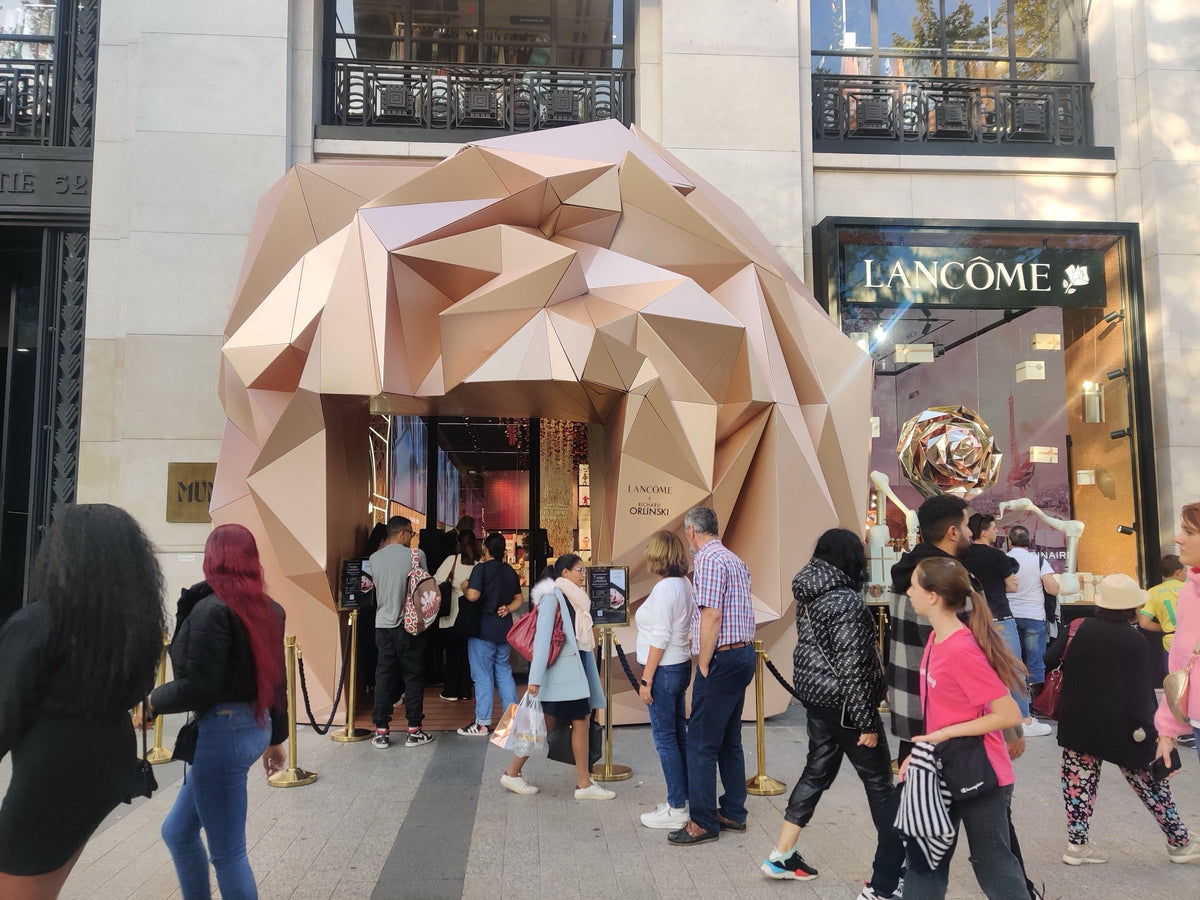
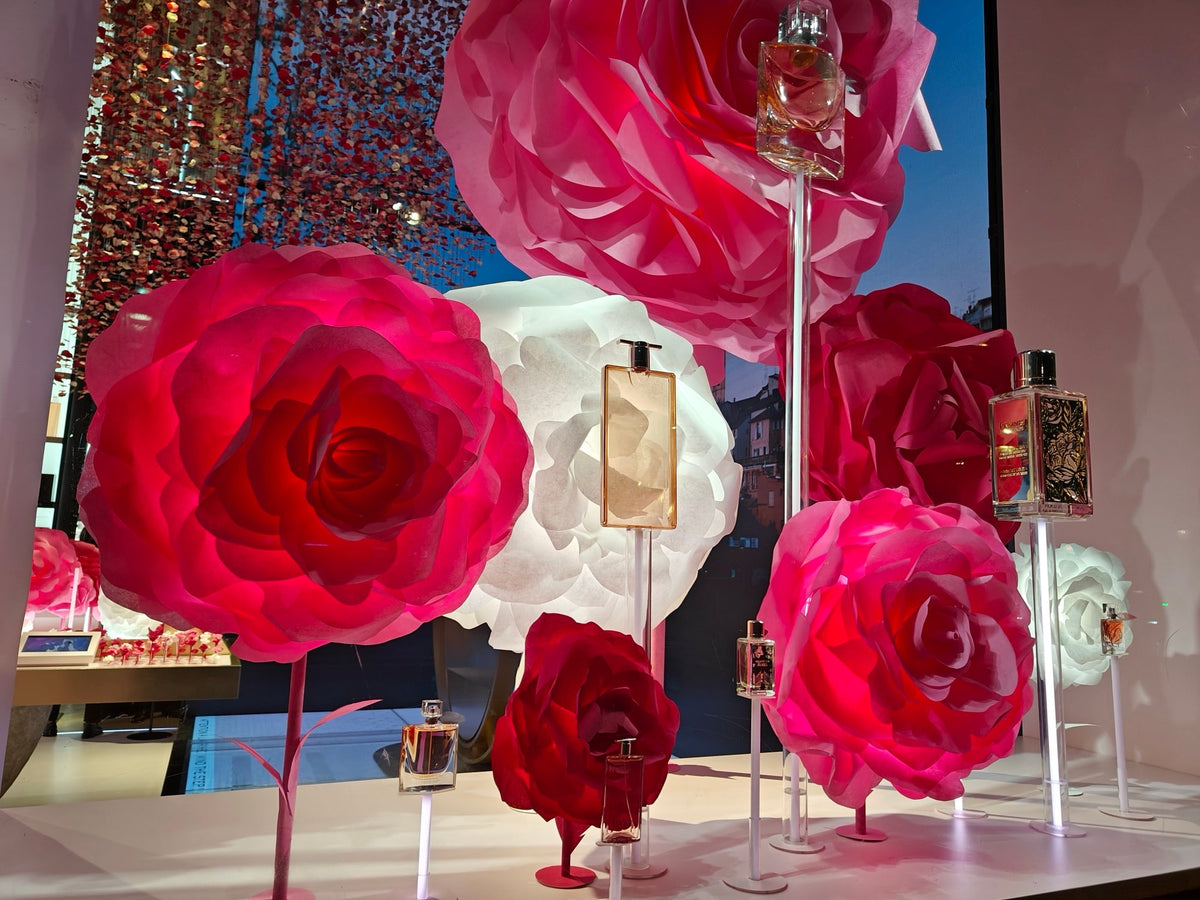
Then there's the most commercial reason. A pleasant store keeps people longer, and a well-placed piece draws shoppers toward a strategic spot. That's what we aimed for with the giant rotating flowers we built for the windows and the interior of the Lancôme flagship on the Champs-Élysées: a slow movement that stops passersby on the sidewalk, then leads them to the products. We explain how to put a window in motion in Animated window displays and rotating stands.

You don't need a major house's budget, or even a big space. In 2019, Hermès filled the window of its Amsterdam store with "The Dream Hunter," a creature handmade from paper and recycled cardboard (designboom). The approach stays the same. Pick one strong gesture, a facade, an object or a movement, that expresses the brand. Decide whether it should be temporary, to create an event, or permanent, to become a landmark. And connect it to the product, so the wonder ends with a test or a purchase. That's what we design and build in our Retailtainment projects, from brief to build.
It's staging a store as an experience: set design, light, movement, sound or scent, all serving the brand's story and the discovery of its products. Art is one of its strongest forms.
Mostly in visibility: visitors create content themselves and share it. Paired with a testing gesture in store, it can also be measured in product discoveries.
Insights
On the big luxury avenues, the window is no longer a few feet of glass. The whole building is the display. Six...
Insights
Every year, stores around the world go big for the holidays. From New York to the Champs-Élysées, here's what the Christmas window...
Guides
An animated window display catches the eye. To bring people inside, the motion also has to lead to the product: let them...
Gaudier designs, deploys and operates interactive in-store devices that let shoppers test beauty and luxury products. Buy or rent, in 30+ countries.